

Stardew Valley fruit trees are lovely until the game tells you one could not grow overnight and refuses to point at the offending tile. The solution is usually simple: understand the clear space around an immature tree, then stop treating a mature tree as if it still has the same restrictions. Here is how I plan an orchard without the nightly frustration.
This focused guide expands the relevant section of my original Stardew Valley YouTube video, with updated mechanics for version 1.6. Jump to the part you need below.
In this guideOpen contents
Plant Stardew Valley fruit trees with room to grow
A normal-quality sapling takes 28 days to mature. It needs a clear 3-by-3 area centred on its trunk while it grows, and neighbouring fruit trees need two tiles between their trunks. Think of each sapling as owning its surrounding ring of tiles.
If you are designing a row, leave two empty positions between one trunk and the next. The same idea applies vertically. Do not cram saplings together and hope the trees will sort themselves out when they get bigger.
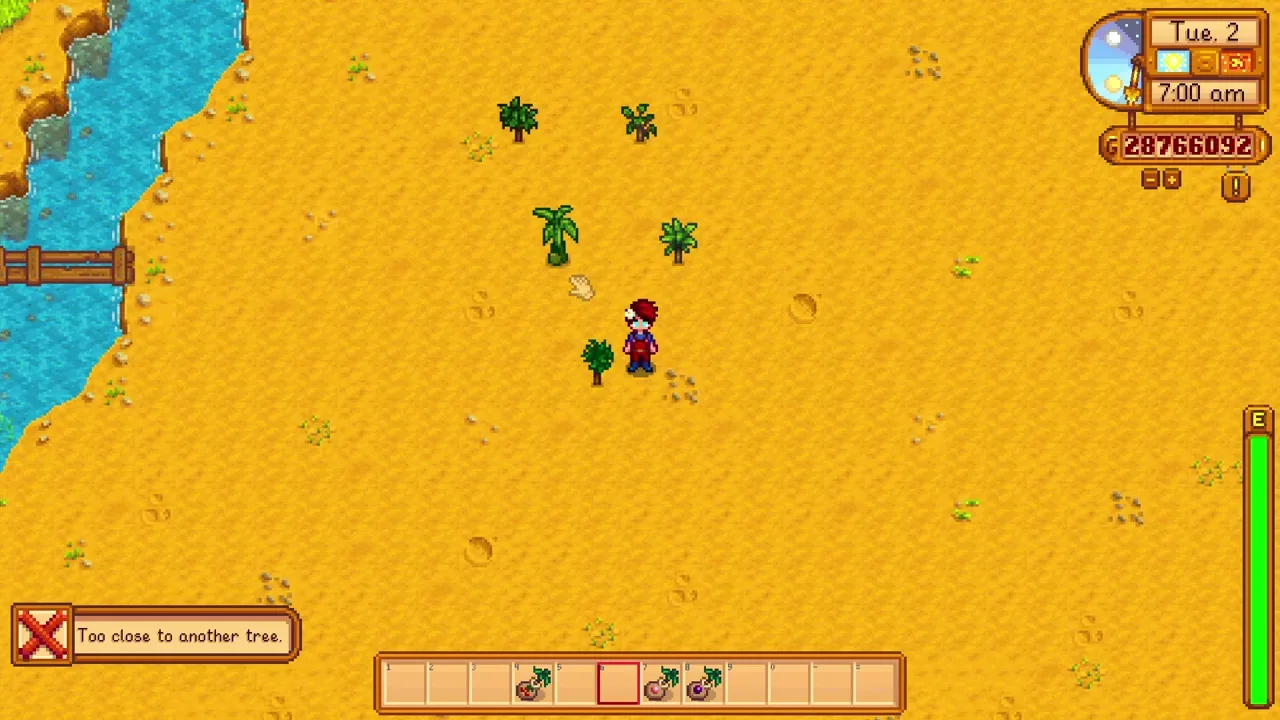
Find the object blocking growth
Inspect the eight surrounding tiles for player-placed objects, paths, debris or other growth obstructions. The most annoying offender is often behind the sapling where the foliage makes it hard to see. Move nearby decorations temporarily if you cannot identify the problem.
Use a clear area while the tree grows and decorate afterwards. There are exceptions for some permanent structures and terrain details, but you do not need to build your first orchard around edge cases. An empty ring is the easy visual rule.
If you planted several saplings, check all of them. The overnight warning does not mean the tree you happened to be looking at is the one that failed.
You do not water fruit trees
Fruit trees do not need daily watering, and Tree Fertilizer does not speed up fruit-tree saplings. That fertilizer belongs to a different tree system. Save the Watering Can work for crops.
Saplings grow in winter too. Planting ahead of the fruiting season is exactly how you get fruit sooner once that season starts. A spring-fruiting tree planted at the beginning of spring will spend most of the season growing instead of paying you back.
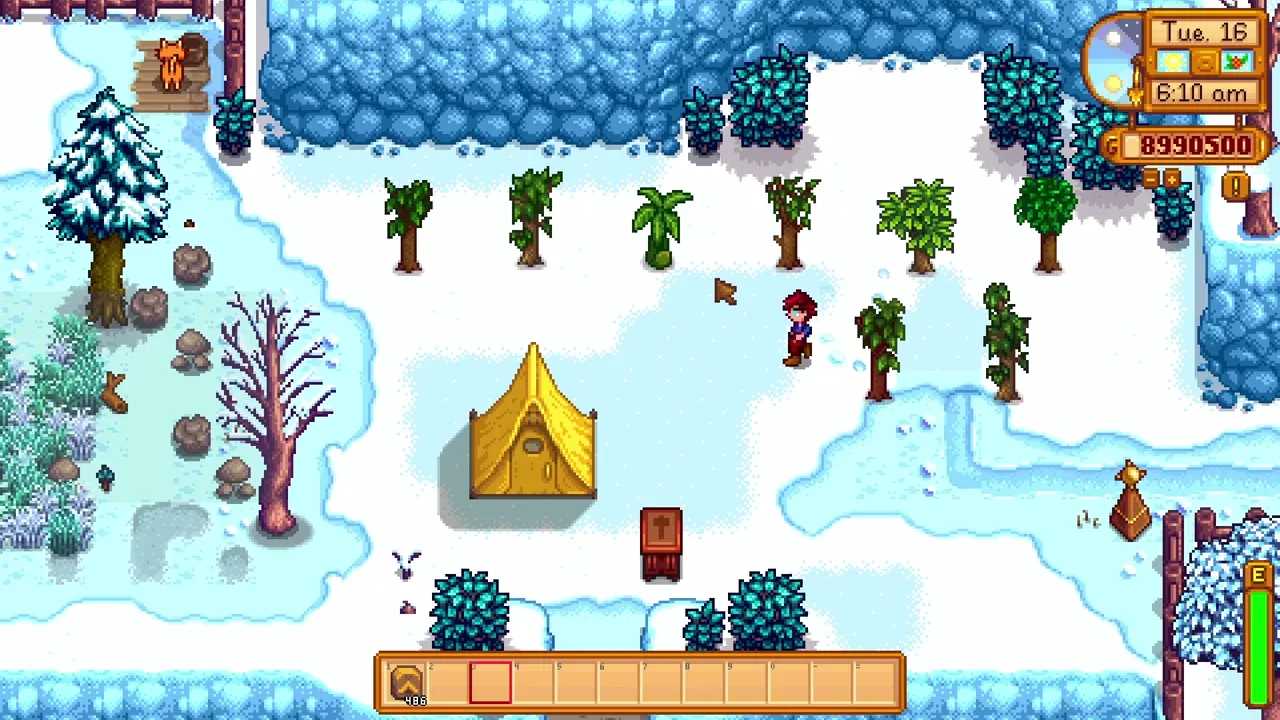
Know the mainland fruiting seasons
A mature outdoor tree produces one fruit per day during its season and stores up to three fruit. It remains alive outside that season; a bare tree is not necessarily a broken tree.
This makes orchard planning different from ordinary crops. You are paying for a long-term plant, not a seed that you must replace after one harvest. Choose fruit you need for bundles, gifts or recipes as well as whatever looks best in the field.
| Season on the main farm | Fruit trees |
|---|---|
| Spring | Apricot and Cherry |
| Summer | Orange, Peach, Mango and Banana |
| Fall | Apple and Pomegranate |
| Winter | No ordinary outdoor fruit production |
The greenhouse and Ginger Island change the schedule
Mature fruit trees produce year-round inside the greenhouse and on Ginger Island. This is why I like using the greenhouse’s outer space for trees while keeping the centre for crops.
The greenhouse walls and built-in decorations behave differently from things you place yourself. You can fit 18 fruit trees around the outer area with a suitable layout, but you still need to keep nearby player-placed items from blocking immature trees. Once the trees mature, you can use more of that space for decoration or machines.
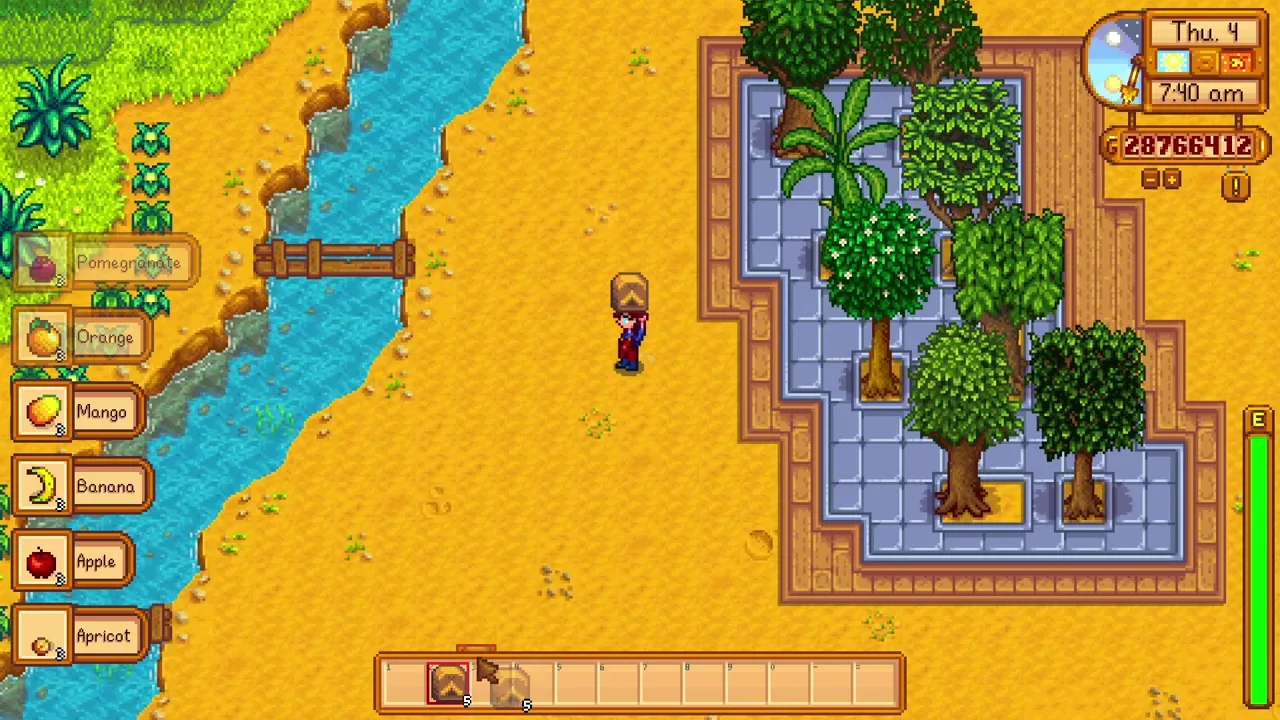
Mature trees can have paths around them
After maturity, nearby paths and objects no longer prevent ordinary fruit production. You also do not need to keep the ring bare forever for the fruit to improve in quality. That is the point where I tidy the orchard and make it look intentional.
Fruit quality improves with the tree’s age. The normal progression is silver after a year of maturity, gold after two and iridium after three. A newly planted normal sapling is not supposed to produce iridium fruit just because you have a high Farming level.
Moving a tree in current versions
In 1.6, chopping down a fruit tree can return a matching sapling, and higher-quality saplings regrow faster. This gives you a way to redesign a poorly placed orchard, but it still interrupts production while the replacement grows.
Do not confuse that with Robin’s building-move service. You are removing the tree and replanting a sapling. Collect its fruit first, choose the new clear position and check what actually returned to the inventory before changing the rest of the orchard.
My rule is to establish the trees before the decorative paths. That little bit of patience avoids most growth messages, and the finished orchard still gets to look good.
Watch the original video

Keep exploring the valley
Find more farming & design guides, or continue with a related guide:
- Best Stardew Valley Greenhouse Layout: 3 Easy Sprinkler Plans
- Best Crops In Stardew Valley 1.6 [ Every Season ]
- 11 Tips to Decorate in Stardew Valley (Plus a Bonus)
Game-mechanics references: Fruit Trees, Greenhouse, Ginger Island. Original gameplay and video by MGaud.